

The history of languages reveals how humans have communicated, connected, and evolved over millennia. Research suggests that human language may have emerged as early as 135,000 years ago, though some theories push this back further to around 1.5 million years with our ancestors like Homo erectus. Today, there are about 7,159 living languages spoken worldwide, but nearly half—around 3,193—are endangered, highlighting the fragility of linguistic diversity. It seems likely that languages began as simple sounds or gestures, evolving into complex systems that shaped societies.
Key points to note:
- Origins: Evidence leans toward language developing gradually from primate communications, with no single “first language” but rather a slow phylogenetic emergence.
- Diversity: The world’s languages are grouped into families like Indo-European (spoken by nearly half the global population) and Sino-Tibetan, reflecting shared ancestral roots.
- Evolution: Migration, conquests, and globalization have spread, merged, and sometimes erased languages, with English emerging as a global lingua franca today.
- Challenges: While globalization connects us, it threatens smaller languages, with one disappearing every few months on average.
- Preservation: Efforts to revive endangered languages underscore their cultural value, though success varies amid modern pressures.
This overview touches on the complexity of the history of languages, acknowledging debates among linguists about exact timelines and mechanisms. For instance, while some emphasize biological adaptations for speech, others highlight social and cultural factors.
Why Study the History of Languages?

Exploring the history of languages helps us understand human migration patterns, cultural exchanges, and even brain evolution. It’s a topic full of intrigue, with ongoing discoveries from fossils, genetics, and ancient texts.
Quick Facts
- Over 40% of languages are at risk of extinction by 2100.
- The Indo-European family includes over 400 languages, from English to Hindi.
- Writing systems, a key milestone, first appeared around 3200 BCE in Mesopotamia.
Have you ever wondered how the words you’re reading right now came to be? The history of languages is like a vast, winding river, carrying stories of human ingenuity, survival, and connection across epochs. In this deep dive, we’ll trace the origins, evolutions, and modern challenges of languages, drawing on historical records, linguistic research, and real-world examples. We’ll explore how languages have shaped civilizations and how they’re adapting—or fading—in our globalized world. Let’s embark on this journey step by step.
Discover More Blogs : Is the Zelle App Shutting Down in 2025?
The Dawn of Communication Origins of Human Language
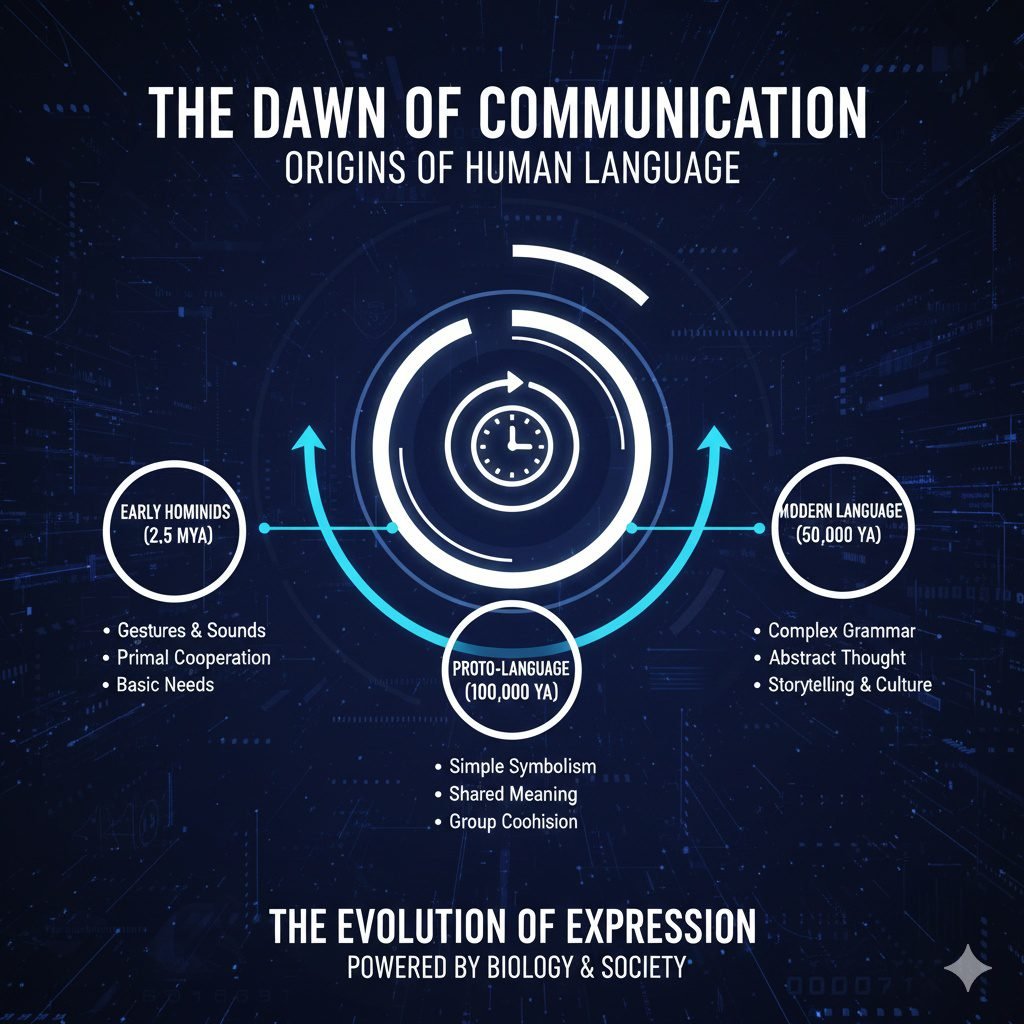
The history of languages begins long before written records, rooted in the mists of prehistory. Linguists and anthropologists debate the exact timeline, but genetic and fossil evidence points to language emerging at least 135,000 years ago, possibly coinciding with early Homo sapiens migrations out of Africa. Some theories, like those from cognitive scientist Steven Pinker or evolutionary biologist Mark Pagel, suggest it could trace back even further—to around 1.5 million years with Homo erectus, who may have had basic vocal capabilities.
Imagine our early ancestors huddled around fires in ancient savannas. They likely started with gestures and simple sounds—grunts, calls, or signs—to warn of dangers or coordinate hunts. This “proto-language” wasn’t as structured as modern tongues but served essential survival needs. Theories abound: the “bow-wow” hypothesis posits that languages mimicked natural sounds (like a dog’s bark becoming “woof”), while the “yo-he-ho” idea ties it to rhythmic group efforts, such as hauling heavy loads. Noam Chomsky’s universal grammar theory argues for an innate human capacity for language, hardwired in our brains.
Fossil records support this gradual evolution. The hyoid bone, crucial for speech, appears in Neanderthals around 60,000 years ago, suggesting they could produce complex sounds. By 50,000–60,000 years ago, symbolic behaviors like cave art indicate advanced communication. Yet, controversies persist—did language arise abruptly through a genetic mutation, or slowly via cultural adaptation? Research leans toward the latter, emphasizing social cooperation as key.
In essence, the history of languages at this stage is about adaptation. As humans spread, so did their ways of speaking, laying foundations for the diversity we see today.
Proto-Languages and the Birth of Language Families
Fast-forward to around 10,000–5,000 BCE, and we enter the era of proto-languages—hypothetical ancestors of modern language groups. These weren’t recorded but reconstructed through comparative linguistics, comparing similarities in words and grammar across languages.
A prime example is Proto-Indo-European (PIE), spoken around 4500–2500 BCE in the Pontic-Caspian steppe. From PIE sprang the Indo-European family, encompassing over 445 languages today, spoken by about 3.2 billion people—nearly half the world’s population. Think English, Spanish, Hindi, and Russian—all sharing roots like “mother” (mater in Latin, mat in Sanskrit).
Other major families include:
- Sino-Tibetan: Home to Mandarin Chinese and Tibetan, with over 1.3 billion speakers. Originating in ancient China around 4000 BCE, it emphasizes tonal variations.
- Afro-Asiatic: Including Arabic and Hebrew, tracing back to Semitic proto-languages in the Middle East around 3750 BCE.
- Niger-Congo: Africa’s largest, with Swahili and Yoruba, featuring complex noun classes and over 1,500 languages.
- Austronesian: Spanning from Madagascar to Hawaii, with roots in Taiwan around 3000 BCE, known for seafaring migrations.
Here’s a table summarizing the top language families by size and reach:
| Language Family | Approximate Number of Languages | Native Speakers (Billions) | Key Regions | Historical Origin |
|---|---|---|---|---|
| Indo-European | 445 | 3.2 | Europe, India, Americas | Pontic-Caspian steppe, ~4500 BCE |
| Sino-Tibetan | 400+ | 1.3 | East Asia | Ancient China, ~4000 BCE |
| Niger-Congo | 1,500+ | 0.7 | Sub-Saharan Africa | West Africa, ~5000 BCE |
| Afro-Asiatic | 375 | 0.5 | Middle East, North Africa | Mesopotamia/Levant, ~3750 BCE |
| Austronesian | 1,200+ | 0.4 | Southeast Asia, Pacific | Taiwan, ~3000 BCE |
(Data compiled from Ethnologue and linguistic overviews.)
These families illustrate how the history of languages is tied to human history—spreading through trade, agriculture, and exploration.
More Blogs Read This : https://cinebench.org/ups-careers/
From Symbols to Scripts The History of Writing Systems

A pivotal chapter in the history of languages is the invention of writing, transforming oral traditions into permanent records. The earliest systems emerged independently in several regions, starting with Sumerian cuneiform in Mesopotamia around 3200 BCE. These wedge-shaped marks on clay tablets initially tracked trade—think accounting for grain or livestock—before evolving to represent sounds and ideas.
Egyptian hieroglyphs followed closely around 3100 BCE, blending pictures with phonetic elements. In China, oracle bone script appeared by 1200 BCE, precursors to modern characters. Mesoamerican systems, like Mayan glyphs, developed around 300 BCE, independently of Old World influences.
Writing systems evolved from logographic (symbols for words) to syllabic and alphabetic. The Phoenician alphabet (circa 1050 BCE) simplified things, influencing Greek, Latin, and eventually most modern scripts. This innovation democratized literacy, fueling empires like Rome’s.
Consider how writing preserved epics: The Epic of Gilgamesh in cuneiform offers glimpses into ancient Mesopotamian life. Without it, much of the history of languages would be lost to time.
Waves of Change Migration, Conquest, and Language Spread
Migration and conquest have profoundly shaped the history of languages, acting as catalysts for blending, dominance, and extinction. As humans moved—for resources, climate, or power—they carried languages, often imposing them on others.
The Indo-European expansion exemplifies this: Nomadic herders from the steppes migrated westward around 3000 BCE, spreading PIE descendants through Europe and Asia via chariots and conquests. Similarly, the Bantu migrations in Africa (starting ~2000 BCE) disseminated Niger-Congo languages across the continent.
Conquests amplified changes. The Norman Conquest of England in 1066 infused Old English with French, birthing Middle English—think words like “beef” (from French boeuf) versus “cow” (Anglo-Saxon). Colonialism later spread European languages globally: Spanish in Latin America, English in India and Africa.
Trade routes like the Silk Road facilitated borrowings—Arabic numerals from India via Muslims, or loanwords like “coffee” from Arabic qahwah. Migration today continues this: Immigrants in the U.S. since the 1840s introduced German and Celtic influences, enriching English with terms like “kindergarten.”
Yet, this often led to language shifts or deaths. Conquered peoples adopted dominant tongues for survival, eroding native ones. Pidgins and creoles emerged from contact, like Haitian Creole from French and African languages.
A table of notable impacts:
| Event/Period | Languages Affected | Key Changes |
|---|---|---|
| Indo-European Migrations | PIE descendants (e.g., Latin, Sanskrit) | Spread across Eurasia, forming branches like Romance and Indo-Iranian |
| Norman Conquest (1066) | English | Vocabulary boom; shift to Middle English |
| Colonial Era (15th-20th C) | Indigenous languages in Americas, Africa | Extinctions; rise of creoles |
| Modern Immigration | Host languages (e.g., U.S. English) | Bilingualism, code-switching |
These dynamics show how the history of languages is inseparable from human movement.
The Global Village Modern Languages and Globalization
In the modern era, the history of languages intersects with globalization, accelerating change at unprecedented speeds. Since the 20th century, technology and trade have elevated English as a global lingua franca, spoken by over 1.5 billion people. Internet and media spread it further—think Hollywood films or social media memes influencing slang worldwide.
Globalization fosters multilingualism but also convergence. Languages borrow freely: Japanese adopts English tech terms like “sumaho” for smartphone. Yet, it threatens diversity—dominant languages like Mandarin or Spanish overshadow minorities.
Statistics paint a picture: 95% of the world speaks just 400 languages, while the rest are niche. In urban hubs like New York, over 800 languages coexist, boosted by migration.
Challenges include “killer languages”—global ones eroding locals, as in Papua New Guinea where Tok Pisin displaces traditions. Positively, apps and AI aid translation, preserving access.
More Info About Blogs : Do a the barrel roll The Iconic Phrase
Facing Extinction Endangered Languages and Preservation Efforts
A somber aspect of the history of languages is the ongoing loss. Of 7,159 languages, 3,193 are endangered, with 43% at risk overall. UNESCO estimates 40% could vanish by century’s end, one every three months.
Hotspots include Indonesia (700+ endangered) and Papua New Guinea. Causes? Urbanization, education in dominant languages, and globalization.
Preservation shines hope: Initiatives like the Endangered Languages Project document tongues like Ainu in Japan. Bilingual education in indigenous communities, such as Maori in New Zealand, revives usage.
Why care? Each language encodes unique knowledge—e.g., Amazonian tribes’ plant lore. Losing them diminishes humanity’s cultural tapestry.
Final Thoughts
Reflecting on the history of languages, it’s clear this story is ongoing. From primal gestures to digital chats, languages mirror our resilience and adaptability. While globalization poses risks, it also offers tools for preservation. As an expert in linguistics, I’d encourage you to learn a new language or support revitalization efforts—it’s a way to honor our shared heritage. The future? Perhaps more hybrid tongues, but with mindful action, diversity can thrive.
Frequently Asked Questions (FAQs)
- What is the oldest known language in the history of languages?
While no single “oldest” exists, Sumerian and Egyptian are among the earliest recorded, dating to around 3000 BCE. - How many language families are there?
Linguists identify over 100, but major ones like Indo-European and Sino-Tibetan dominate. - Why do languages become endangered?
Factors include globalization, migration, and preference for dominant languages in education and media. - How has writing influenced the history of languages?
It preserved knowledge, enabled complex societies, and allowed languages to evolve through standardization. - What role does migration play in language evolution?
It spreads languages, creates hybrids like creoles, and sometimes leads to shifts or extinctions through cultural contact.
Key Citations:
- HISTORY OF LANGUAGE – HistoryWorld
- Language: Its Origin and Ongoing Evolution – PMC
- The Origins and the Evolution of Language – Salikoko Mufwene
- Origin of language – Wikipedia
- Evolution of Language – National Geographic Education
- Language – Evolution, Acquisition, Structure | Britannica
- First Words: A Timeline of Language – Ampersand Travel
- When did human language emerge? | MIT News
- Theories on the Origins of Human Languages – PoliLingua.com
- Q&A: What is human language, when did it evolve and why … – NIH
- 18.16: Chapter 15- The Origins of Language – Social Sci LibreTexts