

Key Points
- Recent Developments: In 2025, Russia and China conducted their annual Maritime Interaction/Joint Sea exercises from August 1-5 in the Sea of Japan, followed by a 15-day joint patrol in the Pacific, marking their fifth such collaboration since 2021. This included a historic first joint submarine patrol, highlighting deeper military ties.
- Strategic Purpose: These Russia-China joint naval Pacific activities focus on anti-submarine warfare, air defense, and search-and-rescue operations, aimed at enhancing interoperability while signaling strength amid tensions with the US and allies like Japan.
- Implications: The exercises raise concerns in the Indo-Pacific, potentially shifting power dynamics, though experts note they are defensive and not targeted at any specific nation—yet they underscore a “no-limits” partnership amid global uncertainties.
- Scale and Frequency: Over 100 joint military exercises since 2012, with naval drills becoming more frequent; in 2024 alone, 11 were held, reflecting accelerated cooperation.
Why These Exercises Matter
Russia China joint naval Pacific exercises represent more than routine training—they symbolize a strategic alignment in a region where maritime security is increasingly contested. With China’s navy now the world’s largest by hull count (over 370 ships) and Russia’s Pacific Fleet maintaining significant submarine capabilities, these drills demonstrate combined force projection. For instance, the 2025 patrol covered vast areas from the Sea of Japan to the Sea of Okhotsk, practicing real-world scenarios like submarine rescues.
Global Context
In a world of rising geopolitical tensions, these activities occur against the backdrop of US-led alliances like AUKUS and QUAD. While Russia faces sanctions over Ukraine, China provides economic support, strengthening their bond. Research suggests this partnership could influence Pacific stability, but it’s balanced by mutual mistrust and differing priorities—Russia focuses on Arctic routes, while China eyes the South China Sea.
What to Watch Next
Future Russia-China joint naval Pacific operations may expand in scope, possibly including more advanced tech like hypersonic missiles. As of December 2025, China’s separate ship massing in East Asian waters hints at broader maritime assertiveness, though not directly tied to Russia.
The Evolution of Russia China Joint Naval Pacific to Cold War Rivals
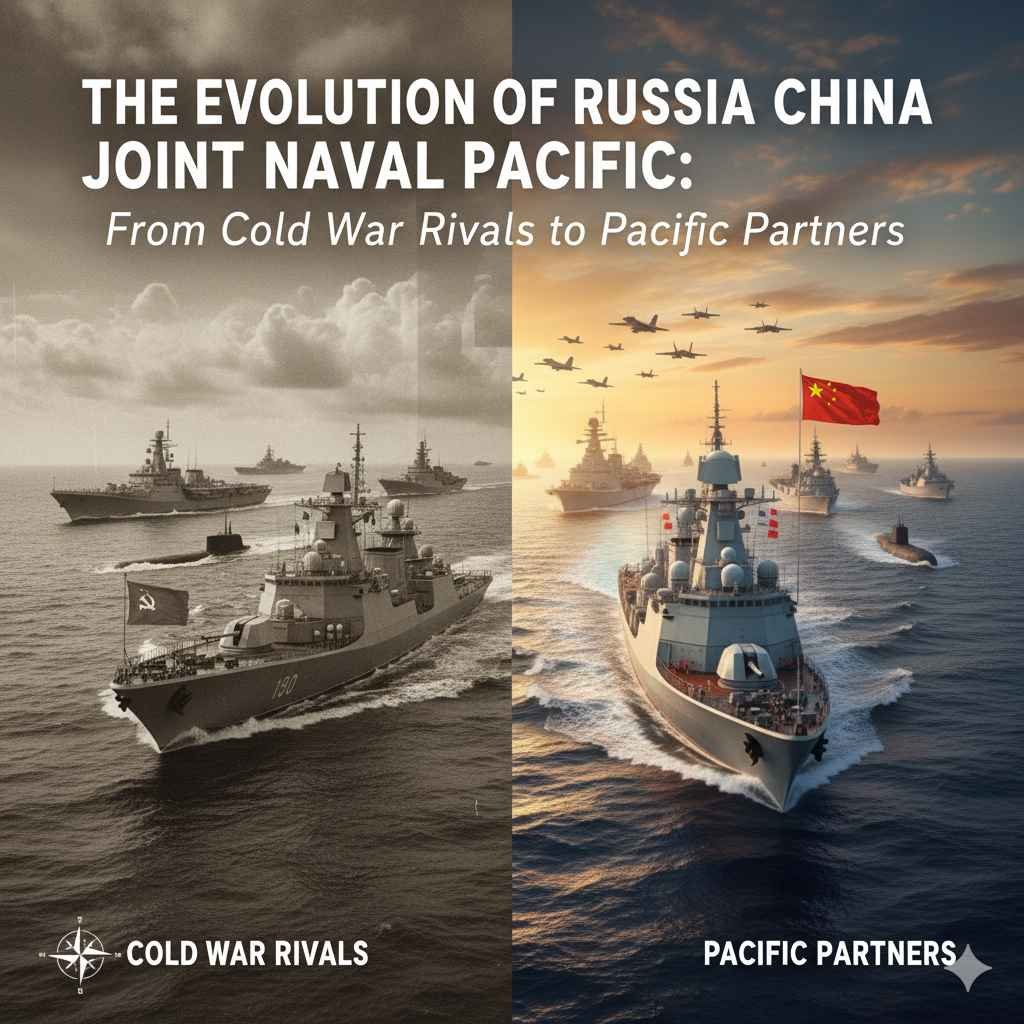
In the vast expanse of the Pacific Ocean, where trade routes crisscross and geopolitical tensions simmer, the sight of Russian and Chinese warships sailing side by side has become increasingly common. The phrase “Russia China joint naval Pacific” captures a phenomenon that’s not just about military drills—it’s a story of shifting alliances, shared ambitions, and a subtle challenge to the established order. As an expert who’s followed these developments for years, I’ll walk you through what these exercises mean, why they happen, and what they could signal for the future. We’ll keep things straightforward, backed by facts, and easy to follow.
Let’s start at the beginning. Russia and China weren’t always on the same team. During the Cold War, they were ideological rivals, with border skirmishes in the 1960s nearly escalating into full conflict. But fast-forward to the post-Soviet era, and things changed. Economic interdependence grew—Russia supplies energy, China provides manufacturing muscle—and military cooperation followed suit. Today, their “no-limits” partnership, declared in 2022 just before Russia’s Ukraine invasion, has turned the Pacific into a stage for joint displays of naval power.
More Blogs Read this : Unlocking PC Power Your Ultimate Guide to Cinebench
A Timeline of Key Milestones
To understand the progression, it’s helpful to look at a chronological overview. Here’s a table summarizing the history of Russia-China joint naval exercises, drawing from reliable sources like the Center for Strategic and International Studies (CSIS) and official defense reports. This isn’t exhaustive, but it highlights the escalation in frequency and complexity.
| Year | Exercise Name | Location | Key Activities | Notable Facts |
|---|---|---|---|---|
| 2012 | Joint Sea-2012 | Yellow Sea (near China) | Anti-submarine warfare, live-fire drills | First bilateral naval exercise; involved 7 Chinese and 9 Russian ships; marked the start of the annual series. |
| 2013 | Joint Sea-2013 | Sea of Japan | Search-and-rescue, air defense | Expanded to include helicopters; focused on interoperability. |
| 2014 | Joint Sea-2014 | East China Sea | Joint maneuvering, artillery firing | Occurred amid South China Sea tensions; Russia sent cruiser Varyag. |
| 2015 | Joint Sea-2015 (two phases) | Mediterranean Sea and Sea of Japan | Amphibious operations, anti-piracy | First exercise outside Asia-Pacific; involved over 20 ships combined. |
| 2016 | Joint Sea-2016 | South China Sea | Island seizure simulations, submarine hunts | Held amid international arbitration on China’s claims; seen as a show of support for Beijing. |
| 2017 | Joint Sea-2017 | Baltic Sea and Sea of Okhotsk | Submarine rescue, joint patrols | First in European waters; highlighted global reach. |
| 2018 | Vostok-2018 (multilateral, but joint elements) | Sea of Japan/Okhotsk | Large-scale maneuvers with 3,000 Chinese troops | Russia’s largest post-Soviet drill; China participated for the first time in Vostok series. |
| 2019 | Joint aerial patrols | Sea of Japan/East China Sea | Bomber flights | First joint air patrol; provoked responses from Japan and South Korea. |
| 2021 | First joint maritime patrol | Western Pacific | Circumnavigation of Japan | Inaugural patrol; ships passed through Tsugaru Strait, alarming Tokyo. |
| 2022 | Vostok-2022 | Sea of Japan | Naval and air operations | Amid Ukraine war; included anti-submarine drills. |
| 2023 | Northern/United-2023 | Sea of Japan | Escort missions, deterrence patrols | Near Alaska; US monitored closely. |
| 2024 | Maritime Interaction-2024 | South China Sea | 11 joint exercises total that year | Accelerated pace; focused on blue-water capabilities. |
| 2025 | Maritime Interaction/Joint Sea-2025 | Sea of Japan/Pacific | Anti-sub, air defense, first joint sub patrol | Fifth annual patrol; historic submarine involvement. |
This table shows a clear trend: from modest beginnings in 2012 with basic drills, the exercises have grown in scope, moving to sensitive areas like the South China Sea and even the Baltic. By 2025, they’ve incorporated submarines—a significant leap in trust and technical coordination.
Diving Deeper The 2025 Exercises in Detail
2025 was a banner year for Russia-China joint naval Pacific activities, with events that grabbed headlines worldwide. It all kicked off on July 31, when Chinese warships— including the guided-missile destroyers Shaoxing and Urumqi, the supply ship Qiandao Lake, and the rescue vessel Xihu—docked in Vladivostok. Russian forces, including anti-submarine ships and diesel-electric submarines like the Varshavianka-class Volkhov, joined them.
From August 1 to 5, the Maritime Interaction-2025 (Russia’s name) or Joint Sea-2025 (China’s) unfolded in the Sea of Japan. The focus? Practical skills like anti-submarine warfare, where IL-38 and Y-8 patrol aircraft simulated hunting enemy subs; air defense against mock aerial threats; search-and-rescue operations, including a groundbreaking submarine rescue drill; and live artillery firing at simulated amphibious targets. This wasn’t just show— it involved real coordination, with submarines practicing underwater maneuvers over 2,000 nautical miles.
Then came the patrol phase. Starting August 6, a joint task force—including Russia’s Admiral Tributs destroyer and China’s Shaoxing destroyer and Qiandaohu oiler—embarked on a 15-day voyage. They transited the La Perouse Strait into the Sea of Okhotsk, stopped at Petropavlovsk-Kamchatsky for resupply, and patrolled vast Pacific waters. This was the fifth annual patrol since 2021, emphasizing joint sailing and anti-submarine missions.
A standout “first” was the joint submarine patrol at the end of August. Russian and Chinese Kilo-class subs, escorted by surface ships, conducted underwater operations in the Sea of Japan and East China Sea. In one scenario, the Russian sub “grounded” in a simulation, and China’s LR-7 rescue vehicle assisted— a testament to growing interoperability. Why submarines? They’re stealthy assets crucial for denying access in contested waters, and sharing tactics here signals deep trust.
By late 2025, discussions on X (formerly Twitter) highlighted ongoing buzz, with posts noting Russian subs near Japan and joint drills as counters to AUKUS expansions. Meanwhile, China’s separate December ship massing—over 90 vessels in East Asian waters—showed unilateral force, practicing mock attacks, though not explicitly joint with Russia.
Strategic Implications Power Plays in the Pacific
So, why all this activity in the Pacific? It’s not random. The region handles 60% of global maritime trade, including vital chokepoints like the Taiwan Strait and Malacca Strait. Russia-China joint naval Pacific exercises serve multiple purposes:
- Enhancing Capabilities: China, with its rapidly modernizing navy (projected to reach 400 ships by 2030), learns from Russia’s submarine expertise. Russia gains access to China’s advanced destroyers and logistics.
- Deterrence Signaling: These drills send a message to the US and allies. In 2023, a patrol near Alaska prompted US shadowing; in 2025, a US destroyer trailed the fleet. It’s like saying, “We’re here, and we’re coordinated.”
- Economic Security: Protecting sea lanes for oil (Russia exports 1.5 million barrels daily to China) and trade routes amid Arctic melting, where Russia claims dominance.
But it’s not without risks. Mistrust lingers—Russia worries about China’s influence in its Far East, and their threat perceptions differ (China vs. US in Taiwan; Russia vs. NATO). Still, with over 100 joint exercises since 2017, the trend is toward closer ties.
Reactions from Around the World
The international community watches closely. Japan, whose 2025 defense white paper flagged these activities, tracked ships through its straits and boosted spending to 2% of GDP. The US views it as part of a broader challenge, with Pacific Command monitoring via destroyers. Taiwan, amid its $40 billion defense hike, sees it as pressure tactics.
Allies like Australia and India express concern— AUKUS subs are a direct response. Yet, both Russia and China insist the drills are defensive, not aggressive. On X, users debate: some see it as “strategic stability,” others as “unsettling” for Southeast Asia.
Looking Ahead What’s Next for Russia-China Naval Cooperation?
As we approach 2026, expect more. Russia has hinted at exercises in the Pacific next month (as of October 2025 posts), possibly including advanced assets. With climate change opening Arctic routes and tensions over Taiwan persisting, joint patrols could extend northward.
Challenges remain: Sanctions limit Russia’s tech, and China’s focus on the South China Sea might diverge. But if history is a guide, frequency will rise—perhaps 12-15 exercises in 2026.
In summary, Russia-China joint naval Pacific activities are a fascinating blend of cooperation and caution. They enhance security for both but stir the pot in a volatile region.
Discovers More Blogs : TNXP Stock A Comprehensive Guide to Tonix …
Frequently Asked Questions (FAQs)
What are Russia-China joint naval exercises in the Pacific?
These are annual military drills where Russian and Chinese navies practice coordinated operations like anti-submarine warfare and patrols in Pacific waters, starting from 2012.
Why do Russia and China hold these exercises?
To improve military interoperability, deter potential threats, and strengthen their strategic partnership amid global tensions. They’re defensive, per official statements.
How often do they happen?
Annually since 2012 for exercises; patrols since 2021. In 2024, 11 joint drills occurred.
What was special about 2025?
It included the first joint submarine patrol, covering 2,000 nautical miles with rescue simulations.
Do these exercises threaten other countries?
Not directly, but they concern the US, Japan, and allies due to power projection. No aggression has resulted, but monitoring is intense.
What’s the difference between exercises and patrols?
Exercises are structured drills (e.g., firing weapons); patrols are longer voyages demonstrating presence, like the 15-day 2025 Pacific tour.
How large are their navies?
China: ~370 ships; Russia: ~60 in Pacific Fleet, strong in subs.
Are there land or air components?
Yes, often integrated—like 2019 air patrols or Vostok ground elements.
What’s the economic angle?
Protects trade; China-Russia bilateral trade hit $240 billion in 2024, much via sea.
Will this lead to a formal alliance?
Unlikely soon— no mutual defense pact, but “no-limits” ties suggest deepening cooperation.
Final Thoughts
As we’ve explored, Russia-China joint naval Pacific exercises are more than spectacles—they’re windows into a multipolar world. While they foster stability for Moscow and Beijing, they remind us of the delicate balance in the Indo-Pacific. Staying informed helps navigate these waters. If tensions ease globally, perhaps these drills could evolve into multilateral peace efforts. For now, they’re a reminder: the sea connects us all, for better or worse.