

Hey there, if you’re in the market for a dependable midsize sedan or just curious about one of the best-selling cars in America, let’s talk about the Toyota Camry. For decades, the Toyota Camry has been a go-to choice for families, commuters, and anyone who values a smooth ride without breaking the bank. In this guide, we’ll explore everything from its rich history to the latest models, features, and tips for ownership. Whether you’re eyeing a new Toyota Camry or maintaining an older one, I’ve got you covered with straightforward insights, stats, and practical advice. Let’s dive in.
A Brief History of the Toyota Camry
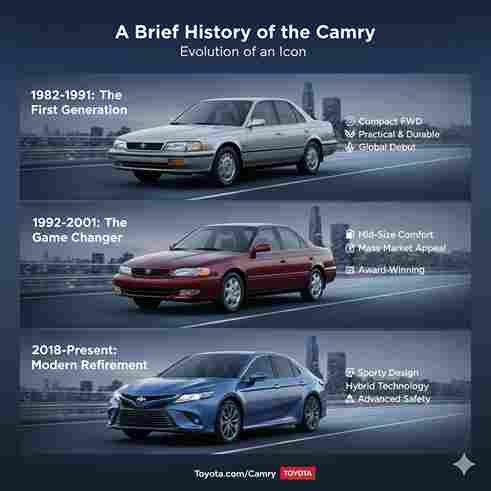
The Toyota Camry story starts back in 1982 when Toyota introduced it as a compact car to replace the Corona. Originally launched in Japan in 1980 as the Celica Camry, it made its U.S. debut in 1983 as a standalone model. The name “Camry” comes from the Japanese word “kanmuri,” meaning crown, symbolizing quality and prestige.
Early on, the Toyota Camry was known for its boxy design and practical appeal. By the late 1980s, it evolved into a more aerodynamic shape, appealing to American buyers who wanted fuel efficiency and comfort. Fast-forward to today, and the Toyota Camry has sold over 21 million units worldwide, with more than 13 million in the U.S. alone. It’s been the best-selling passenger car in America for 22 consecutive years as of 2024, according to Toyota’s sales data.
What makes the Toyota Camry stand out? It’s that perfect blend of innovation and reliability. For example, in the 1990s, it pioneered features like anti-lock brakes in mainstream sedans, setting safety standards. Today, it’s all about hybridization, with the latest models going fully hybrid to meet eco-friendly demands.
Discover More Blogs : https://cinebench.org/digitalconnectmag-com/
Generations of the Toyota Camry From Humble Beginnings to Modern Marvel
The Toyota Camry has gone through nine generations, each building on the last. Here’s a breakdown to help you understand its evolution:
First Generation (V10: 1982-1986)
This was the boxy original, available as a sedan or hatchback. It featured a 2.0-liter engine with about 92 horsepower. Fuel economy was around 25-30 mpg, impressive for the era. Common in Japan but rare in the U.S. now, it laid the groundwork for the Toyota Camry’s reputation.
Second Generation (V20: 1987-1991)
Sleeker and more aerodynamic, this Toyota Camry introduced front-wheel drive standard. Engine options included a 2.5-liter V6 with 153 hp. It was the first to offer all-wheel drive in some markets. Sales boomed, with over 100,000 units sold annually in the U.S.
Third Generation (XV10: 1992-1996)
Bigger and bolder, the Toyota Camry became a midsize sedan. It added a wagon variant and a coupe (Camry Solara). The V6 engine hit 188 hp, and safety features like dual airbags became standard. This gen saw the Toyota Camry top sales charts.
Fourth Generation (XV20: 1997-2001)
Refined interiors and smoother rides defined this era. The 2.2-liter four-cylinder offered 133 hp, while the V6 pumped 194 hp. Fuel efficiency improved to 23/32 mpg. It was during this time that the Toyota Camry earned its “bulletproof” reliability tag from Consumer Reports.
Fifth Generation (XV30: 2002-2006)
More powerful and efficient, with a 3.0-liter V6 at 210 hp. Hybrid rumors started, but it was gas-only. This Toyota Camry focused on comfort, with better noise insulation. Common issues included minor oil leaks, but overall, it was a hit.
Sixth Generation (XV40: 2007-2011)
The first hybrid Toyota Camry debuted in 2007, combining a 2.4-liter engine with electric motors for 187 hp and 34/33 mpg. Gas models had up to 268 hp V6. Styling was bolder, and it won awards for family-friendliness.
Seventh Generation (XV50: 2012-2017)
A redesign brought sharper looks and tech like Entune infotainment. The hybrid got 200 hp and 40/38 mpg. This Toyota Camry emphasized safety, with standard stability control. Sales peaked at over 400,000 units in 2013.
Eighth Generation (XV70: 2018-2024)
Dynamic styling on the TNGA platform improved handling. Engines included a 2.5-liter four-cylinder (203 hp) and 3.5-liter V6 (301 hp). The hybrid hit 208 hp and 51/53 mpg. AWD became available in 2020, a first for non-hybrid models.
Ninth Generation (2025-Onward)
The latest Toyota Camry is hybrid-only, starting with the 2025 model and updates for 2026. More on this below.
This generational progression shows how the Toyota Camry adapts— from basic commuter to tech-savvy hybrid.
The Latest Toyota Camry Models 2025 and 2026 Highlights
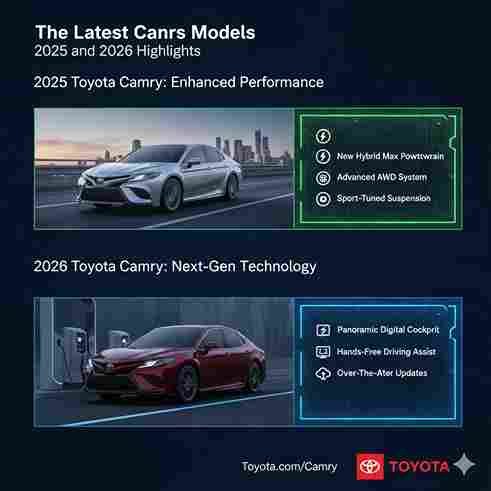
As of December 2025, the Toyota Camry is in its ninth generation, with the 2026 model building on the 2025 redesign. The big news? It’s all-hybrid, ditching pure gas engines for better efficiency. Starting MSRP is around $29,000, making the Toyota Camry accessible.
Key trims for the 2026 Toyota Camry include LE, SE, Nightshade, XLE, and XSE. All feature a 2.5-liter four-cylinder hybrid system with up to 232 net horsepower and 51 combined mpg. AWD is available on most trims, adding versatility for snowy regions.
For example, the LE trim offers 52/49 mpg (city/highway) and basics like an 8-inch touchscreen. The sporty XSE gets 19-inch wheels, sport suspension, and 47/45 mpg. Pricing tops out at about $35,200 for XSE.
Updates for 2026 include refined styling with LED lights, a new Dark Cosmos color, and enhanced tech like a 12.3-inch digital gauge cluster. The Toyota Camry won Kelley Blue Book’s Best New Model for 2025, praising its balance of power and economy.
Performance and Fuel Economy of the Toyota Camry
The Toyota Camry delivers peppy performance without guzzling gas. The 2026 hybrid powertrain combines a gas engine with electric motors for 232 hp, accelerating 0-60 mph in about 7 seconds—quick for a family sedan.
Fuel economy is a standout: Up to 53 mpg city/50 highway on the LE FWD. Real-world tests from owners report 43-50 mpg mixed driving, per Reddit forums. Compared to older gas models (around 28/39 mpg), this is a leap.
Handling is composed, especially on XSE with sport-tuned suspension. AWD models add traction without sacrificing much efficiency (51/49 mpg on LE AWD).
Stats from EPA show the Toyota Camry outperforms rivals in efficiency— for instance, beating the Honda Accord Hybrid’s 48/47 mpg.
More Articles : Smart Pass Your Complete Guide to Digital Hall …
Safety Features in the Toyota Camry
Safety is where the Toyota Camry shines. Every model comes with Toyota Safety Sense 3.0, including:
- Pre-Collision System with Pedestrian Detection
- Lane Departure Alert with Steering Assist
- Full-Speed Range Dynamic Radar Cruise Control
- Lane Tracing Assist
- Road Sign Assist
- Automatic High Beams
Blind Spot Monitor is standard, and higher trims add features like a 360-degree camera. The 2025 Toyota Camry earned a 5-star NHTSA rating and IIHS Top Safety Pick+. In real-world scenarios, like avoiding a deer on a highway, these systems can save lives.
Compared to past generations, crash test scores have improved dramatically— the eighth gen scored perfectly in side impacts.
Reliability and Longevity of the Toyota Camry
The Toyota Camry is synonymous with reliability. Consumer Reports gives the 2025 model a 90/100 overall score, with predicted reliability at 5/5. J.D. Power ranks it high, with fewer than 100 problems per 100 vehicles.
Owners often report 200,000+ miles with basic maintenance. For 2025, the hybrid system is refined from previous gens, minimizing issues. Common praises include durable transmissions and low repair costs— average annual maintenance is $400, per RepairPal.
However, older models (2007-2011) had oil consumption issues, fixed in later years. The 2025 Toyota Camry has three recalls, mostly minor like software updates.
Toyota Camry vs. Competitors: How It Stacks Up
In the midsize sedan segment, the Toyota Camry faces stiff competition. Let’s compare it to the Honda Accord and Hyundai Sonata for 2025.
Toyota Camry vs. Honda Accord
Both are hybrids, but the Toyota Camry edges in mpg (51 combined vs. 48). The Accord has a smoother ride, but Camry’s AWD option is unique. Pricing is similar, starting around $28,000. In tests by Car and Driver, Camry won for efficiency, while Accord for interior space.
Toyota Camry vs. Hyundai Sonata
The Sonata offers bold styling and more tech features like a 12.3-inch dual-screen setup. However, Toyota Camry leads in reliability (CR score 90 vs. 82). Fuel economy is close— Sonata at 39 mpg highway in tests, vs. Camry’s 50. Sonata starts lower at $27,000, but resale value favors Camry.
In a MotorTrend comparison, the Toyota Camry ranked first for overall value, with Accord second and Sonata third.
Table: 2026 Toyota Camry Trim Comparison
| Trim | Starting MSRP | MPG (City/Hwy/Combined) | Key Features | Horsepower |
|---|---|---|---|---|
| LE | $29,000 | 52/49/51 | 8-in touchscreen, dual-zone AC, 16-in wheels | 232 |
| SE | $31,300 | 47/45/46 | 18-in alloy wheels, sport seats, mesh grille | 232 |
| Nightshade | $32,300 | 47/45/46 | 19-in black wheels, rear spoiler, black accents | 232 |
| XLE | $34,000 | 47/45/46 | Leather seats, 12.3-in screen, heated/ventilated seats | 232 |
| XSE | $35,200 | 47/45/46 | Sport suspension, 19-in wheels, dual exhaust | 232 |
This table highlights how the Toyota Camry offers value across trims, with consistent power and efficiency.
Buying Guide for a New or Used Toyota Camry
Shopping for a Toyota Camry? New models offer warranties (3-year/36,000-mile basic, 5-year/60,000-mile powertrain). Look for deals— in 2025, leases start at $259/month for LE.
For used, aim for 2018+ models for modern features. Check Carfax for history. Average used price: $20,000 for 2020 models with 50,000 miles.
Sales stats: In 2025 so far, Toyota sold over 234,000 Camrys, holding 14% market share in sedans. It’s outselling Accord by 20%.
Tips: Test drive for comfort, check hybrid battery health (warranted to 10 years/150,000 miles).
Maintenance Tips for Your Toyota Camry
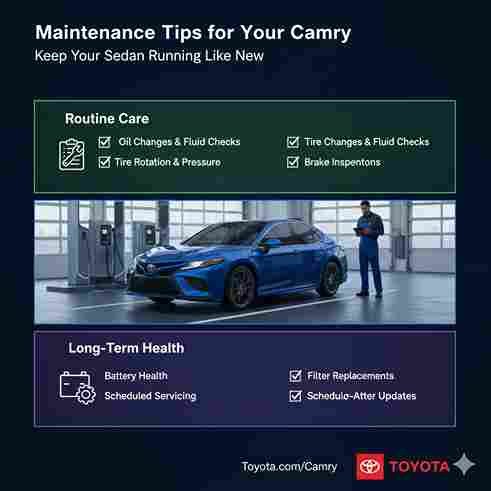
Keeping your Toyota Camry running smoothly is easy. Follow the owner’s manual: Oil changes every 10,000 miles with synthetic oil. Rotate tires every 5,000 miles.
Common problems:
- Oil consumption in 2007-2011 models— monitor levels.
- Transmission hesitation in early 2018s— software update fixes it.
- Brake wear— replace pads every 50,000 miles.
Tips:
- Use genuine Toyota parts for longevity.
- Flush coolant every 100,000 miles.
- Check battery every 3 years.
- For hybrids, avoid extreme heat; park in shade.
Annual costs are low— about $400. Watch YouTube channels like The Car Care Nut for DIY guides.
Market Impact and Sales Success of the Toyota Camry
The Toyota Camry dominates sales, with 309,875 units in 2024 and over 234,000 in 2025 through Q3. It’s up 10.6% year-over-year, per Toyota reports. Market share in midsize sedans is 30%, beating SUVs in efficiency appeals.
Globally, it’s a bestseller in Australia and Asia. In the U.S., it’s favored for low ownership costs— $0.41 per mile, per AAA.
More Info Now https://cinebench.org/chainlist-metamask-techedubyte/:
The Toyota Camry in Pop Culture and Daily Life
From movies like “The Pursuit of Happyness” to everyday commutes, the Toyota Camry represents reliability. Families love its spacious trunk (15 cu ft) for road trips, while Uber drivers praise its durability.
Examples: A 200,000-mile Camry still running strong, as shared on Reddit.
Environmental Aspects of the Toyota Camry
The hybrid Toyota Camry reduces emissions— about 30% less CO2 than gas models. With 51 mpg, it saves $1,000 yearly on fuel vs. 30 mpg cars (at $3/gallon).
Toyota’s push for hybrids aligns with global trends; by 2025, 40% of sales are electrified.
Customizing Your Toyota Camry
Options include alloy wheels, spoilers, and tech upgrades. Aftermarket: Add LED lights or performance exhaust (but check warranty).
For 2026, Nightshade trim offers blacked-out style for a sporty look.
Frequently Asked Questions (FAQs)
1. What is the fuel economy of the 2026 Toyota Camry?
The 2026 Toyota Camry achieves up to 51 combined mpg, with the LE trim offering 52 city/49 highway.
2. Is the Toyota Camry reliable for long-term ownership?
Yes, with proper maintenance, many Toyota Camrys last over 200,000 miles. It scores high in reliability ratings from Consumer Reports.
3. What are the main differences between Toyota Camry trims?
Trims vary in styling, wheels, and features— LE is basic and efficient, while XSE is sportier with tuned suspension.
4. How does the Toyota Camry compare to the Honda Accord?
The Toyota Camry offers better fuel economy and available AWD, while the Accord has a slightly roomier interior.
5. What common problems should I watch for in older Toyota Camrys?
Oil consumption in 2007-2011 models and minor transmission issues in early 2018s, but newer models are very reliable.
Final Thoughts
The Toyota Camry isn’t just a car— it’s a reliable partner for life’s journeys. From its humble 1980s roots to the efficient 2026 hybrid, it evolves while staying true to affordability and dependability. With top safety, impressive mpg, and strong resale value, the Toyota Camry remains a smart choice in a SUV-dominated world. If you’re considering one, test drive it; you’ll see why millions choose it. Safe travels!