

Ever wondered how your favorite apps talk to each other? That’s where APIs come in. Short for Application Programming Interface, an API acts like a messenger that lets different software systems share data and functions without exposing their inner workings.
In simple terms, what is an API? It’s a set of rules that allows one program to request services or data from another. Think of it as ordering food through a waiter—you don’t need to know the kitchen details; you just make your request.
This guide explains what an API is, how it works, common types, real-world examples, and why it matters in 2025.
What Is an API Matter in 2025
APIs power modern digital life. They enable seamless experiences across apps, websites, and devices. From logging in with Google to checking weather on your phone, APIs make it happen.
Key stats highlight their growth:
- The global API management market reached ~$7-10 billion in 2025 and is projected to hit $100+ billion by 2033 (CAGR ~25-35%).
- Over 82% of organizations now adopt an “API-first” approach.
- Public APIs number in the tens of thousands, with millions of calls daily.
APIs drive innovation in AI, mobile apps, and cloud services.
More Articles : What is Tikcotech? A Comprehensive Guide Tech Platform
How Does an API Work?
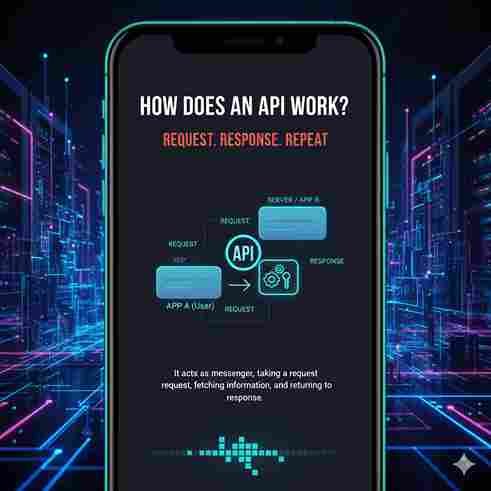
An API works through requests and responses, usually over the internet using HTTP.
Basic flow:
- Client (your app) sends a request to the API endpoint (a specific URL).
- The server processes the request.
- It sends back a response (often in JSON format) with the requested data or confirmation.
Example: When you search for a location in a ride-sharing app, it calls the Google Maps API to get directions.
Types of APIs
Several architectural styles exist for building APIs. Each suits different needs.
| Type | Description | Pros | Cons | Best For |
|---|---|---|---|---|
| REST | Uses standard HTTP methods (GET, POST) | Simple, scalable, cacheable | Can cause over/under-fetching | Web/mobile apps |
| SOAP | XML-based protocol with strict rules | Secure, built-in standards | Heavy, complex | Enterprise/finance |
| GraphQL | Query language for precise data requests | Flexible, reduces over-fetching | Learning curve | Complex data needs |
| Webhooks | Server pushes data on events | Real-time, efficient | Hard to debug | Notifications |
| gRPC | High-performance, uses Protocol Buffers | Fast, supports streaming | Less human-readable | Microservices |
REST remains the most popular (~70% usage), followed by webhooks and GraphQL.
Popular API Examples
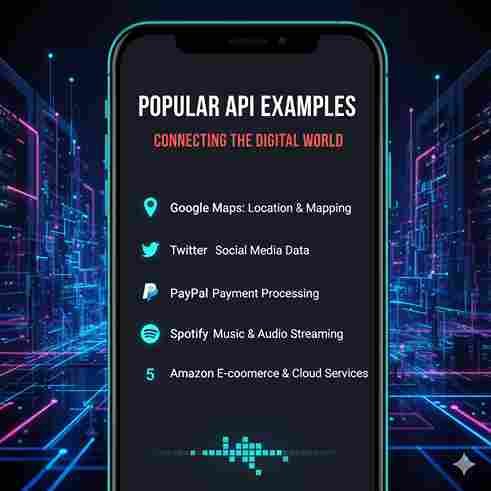
Many companies provide public APIs for developers.
- Google Maps API: Adds maps, directions, and location services to apps.
- Stripe API: Handles payments, subscriptions, and fraud detection easily.
- OpenAI API: Powers AI features like chatbots and content generation.
- Twilio API: Sends SMS, calls, and emails.
- OpenWeatherMap API: Delivers real-time weather data.
These APIs let developers build features quickly without starting from scratch.
Discover More Blogs : https://cinebench.org/white-screen/
How to Use an API Step-by-Step
- Sign up for an API key (most require authentication).
- Read documentation—it shows endpoints, methods, and examples.
- Make a request using tools like Postman or code (e.g., JavaScript fetch).
- Handle the response—parse JSON and display data.
- Test and monitor usage limits.
Example request (REST):
GET https://api.openweathermap.org/data/2.5/weather?q=London&appid=YOUR_KEYBenefits of Using APIs
- Speed up development—reuse existing services.
- Improve scalability—handle more users easily.
- Enable innovation—combine services for new features.
- Enhance user experience—seamless integrations.
In 2025, APIs are essential for digital transformation.
Common API Challenges and Solutions
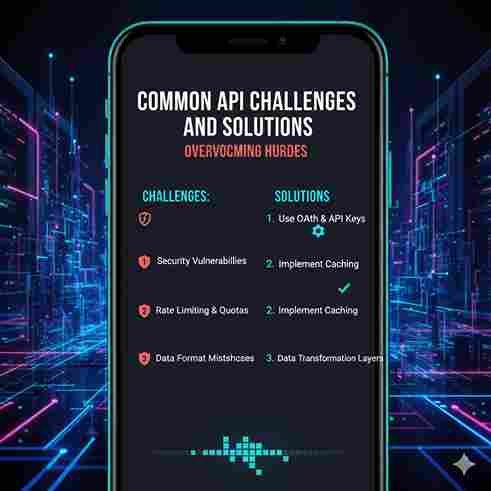
- Security risks: Use HTTPS, OAuth, and rate limiting.
- Rate limits: Monitor usage and implement retries.
- Versioning: Plan for backward compatibility.
- Documentation: Keep it clear and up-to-date.
Good practices prevent most issues.
Discover More Blogs : https://cinebench.org/joinpd/
Final Thoughts
What is an API? Simply put, it’s the glue connecting our digital world. From simple data fetches to complex AI integrations, APIs make modern apps possible. As the API economy grows rapidly, understanding them helps developers build better products faster.
Mastering APIs opens endless possibilities. Start exploring one today—your next project might depend on it.
Discover More Blogs : https://cinebench.org/android-back-key/
FAQs
1. What does API stand for?
Application Programming Interface.
2. Is an API the same as a website?
No—APIs are for software-to-software communication, while websites are for humans.
3. Are all APIs free?
Many offer free tiers, but popular ones like Google Maps or OpenAI charge based on usage.
4. Why do developers love REST APIs?
They’re simple, use standard web tech, and scale well.
5. How secure are APIs?
They can be very secure with proper authentication, encryption, and monitoring.