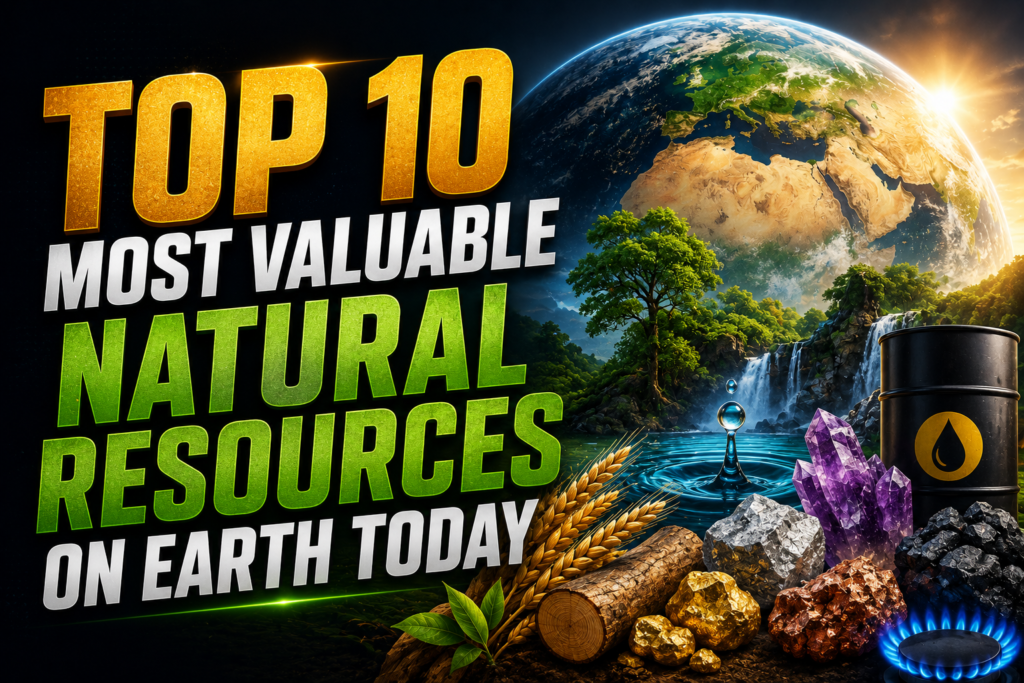
The global economy is entirely dependent on the materials extracted from the Earth. From the energy fueling smart grids to the rare minerals driving the green energy transition, the raw valuation of these materials dictates global power dynamics, inflation rates, and technological progress.
The economic worth of a commodity is determined by its scarcity, market demand, and extraction complexity. This article breaks down the top 10 most valuable natural resources on Earth today, mapping their economic utility, strategic importance, and overall market presence.
The Global Resource Matrix: A Quick Comparison
Before analyzing each resource, the table below provides a snapshot of the world’s most critical natural resources, their core industrial drivers, and the dominant producing nations in the market.
| Natural Resource | Primary Economic Driver | Leading Global Producers |
| Water (Freshwater) | Agriculture, Human Survival, Industry | Brazil, Russia, Canada |
| Crude Oil (Petroleum) | Transportation, Petrochemicals, Energy | United States, Saudi Arabia, Russia |
| Natural Gas | Power Generation, Heating, Industrial Feedstock | United States, Russia, Iran |
| Gold | Financial Reserves, Electronics, Jewelry | China, Australia, Russia |
| Lithium | EV Batteries, Grid Storage, Electronics | Australia, Chile, China |
| Rare Earth Elements (REEs) | Defense Systems, Magnets, Smartphones | China, United States, Myanmar |
| Coal | Electricity Generation, Steel Production | China, India, Indonesia |
| Iron Ore | Infrastructure, Steel Manufacturing | Australia, Brazil, China |
| Copper | Electrical Wiring, Construction, Green Tech | Chile, Peru, Dem. Rep. of Congo |
| Timber | Construction, Paper Industry, Biomass | United States, Russia, Canada |
Deep Dive: The Top 10 Most Valuable Natural Resources
1. Water (Freshwater)
While gold and oil capture financial headlines, freshwater is indisputably the most valuable resource for human survival and economic stability. It serves as the backbone of global agriculture, industrial manufacturing, and thermoelectric power cooling systems.
The challenge with water is its uneven distribution and non-substitutable nature. As populations expand and climate volatility alters hydrological cycles, access to clean freshwater has become an issue of national security and a primary constraint on economic growth.
- Key Value Driver: High-yield agricultural irrigation and manufacturing processes.
- Economic Vulnerability: Severe supply depletion risks driven by over-allocation and contamination.
2. Crude Oil (Petroleum)
Crude oil remains the primary fuel source for global transport networks and the foundational raw material for the modern petrochemical industry. Plastics, pharmaceuticals, synthetic fibers, and fertilizers all rely directly on petroleum derivatives.
Despite aggressive international decarbonization targets and the accelerating adoption of electric vehicles, global oil demand remains high. Its high energy density and deeply entrenched infrastructure guarantee its position as a dominant geopolitical asset.
- Key Value Driver: Liquid fuel for aviation, maritime shipping, and heavy freight transport.
- Geopolitical Hotspots: The Middle East (OPEC block), North American shale basins, and Siberian fields.
3. Natural Gas
Often categorized as a transitional fossil fuel, natural gas is highly valued for emitting less carbon dioxide per unit of energy than coal or oil. It plays a dual role in the energy sector: providing steady baseline power to electric grids and acting as a critical feedstock for producing nitrogen-based fertilizers via the Haber-Bosch process.
The expansion of Liquefied Natural Gas (LNG) infrastructure has transformed this historically regional commodity into a fluid, highly integrated global market.
[Natural Gas Extraction] ──> [Cryogenic Liquefaction (-162°C)] ──> [Global LNG Shipping] ──> [Regasification & Grid Injection]
4. Gold
Gold is the ultimate financial hedge and a historical store of value. Unlike fiat currencies, gold cannot be printed, making it a reliable safeguard against high inflation, currency devaluation, and macroeconomic instability.
Beyond its prominent status in central bank reserves and luxury jewelry, gold possesses exceptional physical properties. Its resistance to corrosion and excellent electrical conductivity make it a critical component in high-reliability microelectronics, aerospace computing systems, and specialized medical diagnostic equipment.
- Market Function: Safe-haven asset during times of geopolitical conflict and market volatility.
- Industrial Use: Corrosion-free contact points in advanced semiconductors.
5. Lithium
Lithium is the core component of the modern energy storage revolution. As the lightest metal on the periodic table, it offers an unmatched power-to-weight ratio, making it an irreplaceable element for lithium-ion battery chemistries.
The rapid scaling of electric vehicle production and grid-scale renewable energy storage has transformed lithium from a niche chemical into a highly strategic commodity. Securing stable domestic supply chains for lithium processing is now a major policy priority for major industrial economies.
- Primary Application: Cathode manufacturing for high-energy-density rechargeable batteries.
- The “Lithium Triangle”: High-altitude brine deposits found across Chile, Argentina, and Bolivia.
6. Rare Earth Elements (REEs)
Rare Earth Elements are a group of 17 chemically similar metallic items, including Neodymium, Dysprosium, and Lanthanum. Despite their name, these materials are relatively abundant in the Earth’s crust, but they are rarely found in concentrated, economically viable deposits.
Extracting and refining REEs is a complex, chemically intensive process. These elements are vital for manufacturing high-strength permanent magnets used in electric vehicle motors, wind turbines, precision-guided missile defense systems, and consumer electronics.
- Critical Risk Factor: Extreme geographic consolidation of extraction and refining operations, primarily inside China.
- Technological Dependency: Vital for building efficient, compact electric motors and clean energy generators.
7. Coal
Despite being a primary target for global emissions reduction efforts, coal remains the largest single source of electricity generation worldwide. It provides cheap, highly reliable baseline power to rapidly developing industrial economies, particularly across the Asia-Pacific region.
Beyond energy, metallurgical coal (coke) is an essential reducing agent used in blast furnaces to transform iron ore into steel. Until commercial-scale green hydrogen steelmaking technologies mature, coal will remain fundamentally linked to global infrastructure development.
- Thermal Coal: Used for high-volume, low-cost electricity generation.
- Metallurgical Coal: Essential component for standard global steel production.
8. Iron Ore
Iron ore is the primary raw ingredient needed to produce steel. It is the literal foundation of modern civilization, utilized in everything from skyscrapers and transport bridges to container ships, rail networks, and heavy machinery manufacturing.
Because of the massive scale required for industrial development, global iron ore consumption is a direct indicator of economic health, industrial output, and infrastructure spending.
- Market Characteristics: High-volume commodity driven heavily by urban construction cycles.
- Major Extraction Hubs: The massive open-pit mines of Western Australia and the Carajás region in Brazil.
9. Copper
Copper is the primary conductor of the modern world. Its superior electrical and thermal conductivity, combined with its high ductility, makes it an essential component for power grids, building wiring, electronic circuitry, and electric vehicle drivetrains.
The global transition toward electrification has driven copper demand to historic highs. An electric vehicle requires up to four times more copper than a traditional internal combustion engine car, and upgrading electrical grids to handle renewable energy inputs demands massive quantities of new copper wiring.
- Economic Moniker: “Doctor Copper” — because its market price effectively diagnoses the overall health of the global manufacturing sector.
- Supply Challenges: Declining ore grades in historical mines and long lead times required to bring new mining projects online.
10. Timber
Timber is one of the few truly renewable materials on this list, provided it is managed through sustainable forestry practices. It is a fundamental component of the global construction industry, used for structural framing, flooring, and engineered wood products.
Additionally, timber serves as the primary source material for the pulp and paper industry and is increasingly utilized as a source of biomass energy. Beyond its raw commercial valuation, standing forests provide critical global economic value through carbon sequestration and ecosystem preservation.
- Commercial Use: Structural construction material and global packaging supply chains.
- Sustainability Metric: Requires careful balance between industrial logging output and active reforestation efforts.
Conclusion
The valuation of natural resources is shifting as the global economy undergoes a structural transition. While traditional fossil fuels like oil and natural gas continue to command massive market volume and financial capital, critical minerals like lithium, copper, and rare earth elements are rapidly rising in strategic and financial value.
At the same time, fundamental resources like freshwater highlight that the most valuable assets on Earth are ultimately those that sustain life itself. True economic resilience for any nation will depend on balancing the extraction of these valuable commodities with sustainable resource management and environmental stewardship.
More Blogs : The Toyota Camry A Timeless Sedan That Defines Reliability
Frequently Asked Questions (FAQs)
What makes a natural resource “valuable”?
A resource’s value is determined by its scarcity, the difficulty of its extraction, and its utility in driving industrial production or human survival.
Is water more valuable than oil?
Yes, from a survival and foundational economic standpoint, water is irreplaceable and vital for agriculture and industry, whereas energy sources can be diversified.
Why are Rare Earth Elements so critical if they aren’t actually rare?
While fairly common in the Earth’s crust, they are rarely found in concentrated deposits, and their refining process is technically difficult and environmentally hazardous.
Will lithium remain valuable over the next decade?
Yes, the global push for electric vehicles and grid-scale battery storage guarantees sustained long-term demand for high-quality lithium supplies.
Which country possesses the highest total value of natural resources?
Russia holds the world’s largest total resource reserves, valued at an estimated $75 trillion, largely driven by its vast natural gas, coal, and timber allocations.
How does copper impact the green energy transition?
Copper is essential for all electrification technologies, meaning wind, solar, and electric vehicle infrastructure require significantly more copper than traditional fossil fuel systems.
For a deeper look into how global energy markets and critical mineral dependencies are evolving, you can watch this comprehensive breakdown on 15 Natural Substances More Valuable than GOLD. This video provides helpful historical and scientific context on why certain raw materials command such an immense premium over traditional precious metals.